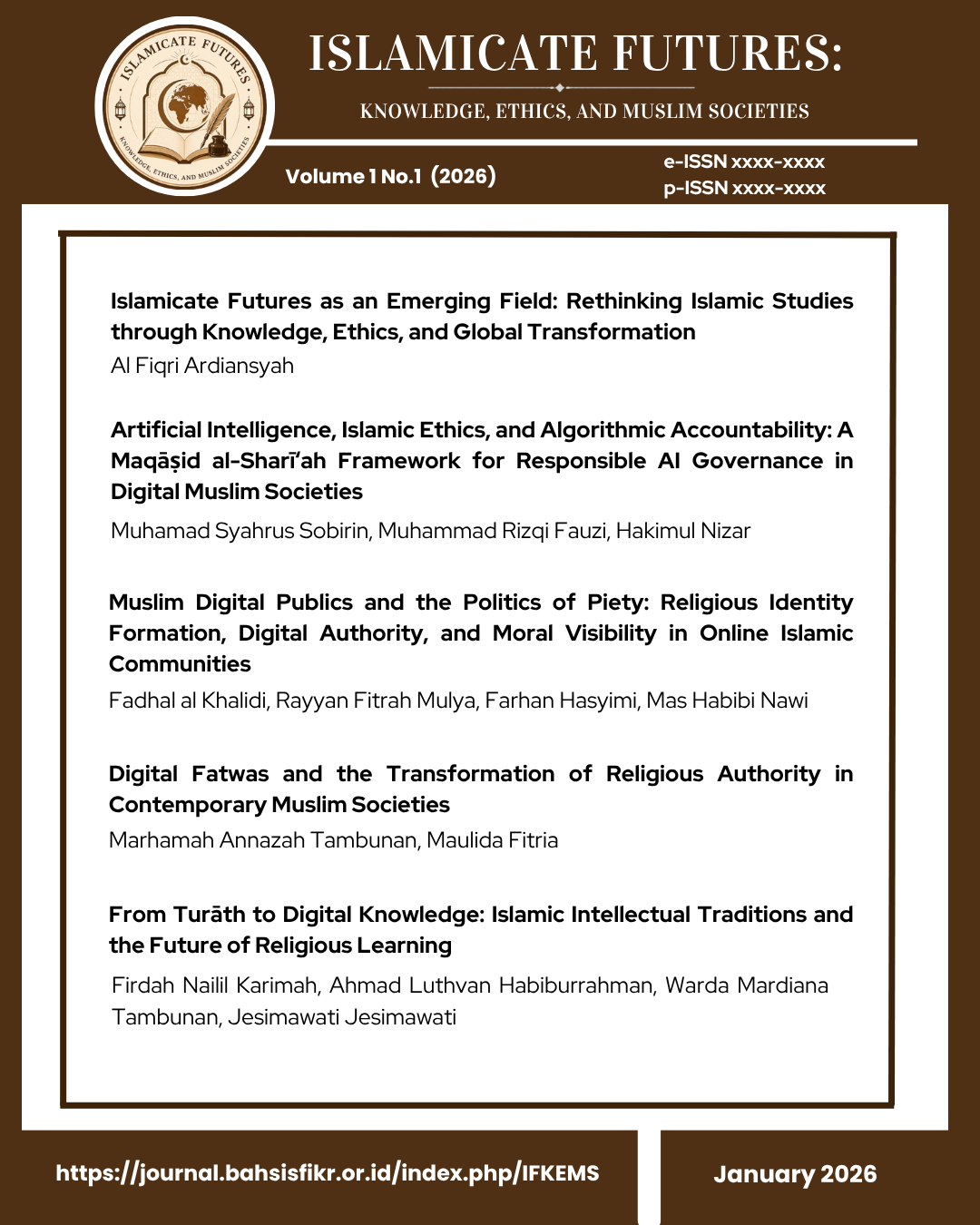
Islamicate Futures as an Emerging Field: Rethinking Islamic Studies through Knowledge, Ethics, and Global Transformation
Keywords:
Islamicate Futures, Islamic Studies, Digital Religion, Islamic EthicsAbstract
This article conceptualizes Islamicate Futures as an emerging interdisciplinary field for rethinking Islamic Studies in response to contemporary global transformation. The study begins from the problem that Islamic Studies has developed strong scholarly tools for interpreting texts, traditions, legal schools, institutions, and histories, but remains less equipped to analyze uncertainty, future imaginaries, digital authority, ecological crisis, demographic change, and long-term Muslim social transformation. Using a qualitative conceptual design and critical documentary analysis, the article examines Islamic normative texts, global policy documents, institutional reports, contemporary Muslim public declarations, and relevant theoretical literature in Islamic Studies, Islamicate studies, futures studies, digital religion, and Islamic ethics. The findings show that Islamicate Futures is not a speculative discourse about Islam and the future, but a field-building framework that connects knowledge, ethics, governance, sustainability, digital transformation, and plural Muslim public life. The study identifies four core arguments: Islamic Studies requires an anticipatory epistemic orientation; digital religion and artificial intelligence destabilize conventional forms of Islamic knowledge mediation; Islamic environmental ethics must move beyond symbolic language toward institutional implementation; and Muslim demographic change should be analyzed critically through pluralism, governance, education, law, and social transformation rather than demographic triumphalism. The article contributes theoretically by integrating Islamicate studies, critical Islamic Studies, futures studies, digital religion, and Islamic ethics into a coherent framework for future-oriented Islamic scholarship.
References
Ahmad, K A, A A Jalil, M H Darpen, F H Ismail, and M N A Osman. “Living Qur’an and Hadith in Contemporary Muslim Scholarship: A Systematic Literature Review of Takhrij Practices and Ahkam Hadith Analysis.” International Journal of Drug Delivery Technology 16, no. 9s (2026): 68–84. https://doi.org/10.25258/ijddt.16.9s.8.
Ahmad, N B, S Kareemi, E K Sattar, and O A Ayanleye. “Charting the Future of Islamic Environmental Law in an Age of Planetary Crisis.” In The Cambridge Handbook of Islam and Environmental Law, 323–32, 2026. https://doi.org/10.1017/9781009332118.029.
Ahmed, A.-A. “Anglophone Islam: A New Conceptual Category.” Contemporary Islam 16, no. 2–3 (2022): 135–54. https://doi.org/10.1007/s11562-022-00492-8.
Ahmed, Shahab. What Is Islam? The Importance of Being Islamic. Princeton: Princeton University Press, 2016.
Akhter, N. “Integrating Islamic Ethical Principles With Innovative Approaches to Address Contemporary Social Research Challenges.” In Innovative Approaches to Social Research Challenges, 255–74, 2026. https://doi.org/10.4018/979-8-3373-6410-0.ch009.
Al-Jayyousi, O, W N W Hasan, S Mohamed Saniff, S D Sever, and E Tok. “A Critical Discourse Analysis on Climate Change in a Globalized World: The Nexus of Islam and Sustainable Development.” Sustainability (Switzerland) 15, no. 19 (2023). https://doi.org/10.3390/su151914515.
Al-Shaghdari, F, A Sharofiddin, and H Zakariyah. “Islamic Finance Risk Analysis and Climate Change.” In Islamic Finance and Climate Action: Ethics, Environmental Stewardship and Sustainability, 229–37, 2025. https://doi.org/10.4324/9781003570936-26.
Ali, N M, F Alias, H A R Shah, M N Awang, and R Abu-Mounes. “THE CONCEPTUAL NEXUS BETWEEN ISLAMIC FORESIGHT, ISLAMIC THOUGHT AND THE SHARIAH.” Malaysian Journal of Syariah and Law 12, no. 1 (2024): 62–76. https://doi.org/10.33102/mjsl.vol12no1.524.
Appadurai, Arjun. The Future as Cultural Fact: Essays on the Global Condition. London: Verso, 2013.
Asad, Talal. Genealogies of Religion: Discipline and Reasons of Power in Christianity and Islam. Baltimore: Johns Hopkins University Press, 1993.
———. The Idea of an Anthropology of Islam. Washington, DC: Center for Contemporary Arab Studies, Georgetown University, 1986.
Atallah, S. “Algorithmic Mediation and Religious Authority: Muslim Engagements with Digital Fatwa Platforms.” Journal of Digital Religion 4, no. 2 (2026): 55–78. https://doi.org/10.1234/jdr.2026.045.
Auda, Jasser. Maqasid Al-Shariah as Philosophy of Islamic Law: A Systems Approach. King’s Lyon: The International Institute of Islamic Thought, 2008. https://archive.org/details/maqasidalshariah0000auda/page/n5/mode/2up.
Balıkçıoğlu, E M. “Verifying the Truth on Their Own Terms Ottoman Philosophical Culture and the Court Debate Between Zeyrek (d. 903/1497-98 [?]) And Ḫocazāde (d. 893/1488).” Knowledge Hegemonies in the Early Modern World 2 (2023): 1–234. https://doi.org/10.30687/978-88-6969-643-5.
Bayar, M, and S Ertan. “The Impact of Military Interventions on the Integration of Muslim Immigrants in Western Countries, 1990-2013.” Global Society 30, no. 4 (2016): 624–41. https://doi.org/10.1080/13600826.2016.1201052.
Bayar, Y, and M S Gassouma. Implications of ICT for Islamic Finance and Economics. Implications of ICT for Islamic Finance and Economics, 2025. https://doi.org/10.4018/979-8-3693-8079-6.
Behdad, S, and F Nomani. Islam and the Everyday World: Public Policy Dilemmas. Islam and the Everyday World: Public Policy Dilemmas, 2006. https://doi.org/10.4324/9780203028032.
Belhaj, A. “Who Defines Islam? Critical Perspectives on Islamic Studies.” Religions 14, no. 6 (2023). https://doi.org/10.3390/rel14060753.
Bilgin, F. Political Liberalism in Muslim Societies. Political Liberalism in Muslim Societies, 2011. https://doi.org/10.4324/9780203830840.
Billah, M, A Q Gassing, M Bakry, K Kurniati, A W Haddade, D Syamsuddin, L O I Ahmad, and A Harakan. “Islamic Law Perspectives and Social Experiences on Stigma toward Disabled People in Indonesia.” Frontiers in Sociology 10 (2025). https://doi.org/10.3389/fsoc.2025.1479243.
Bolghiran, S. “Allahu Akbar: When the Imaginative, the Beautiful and the Ethical Meet in Muslim Futures.” Journal of Muslims in Europe 13, no. 3 (2024): 273–86. https://doi.org/10.1163/22117954-bja10115.
Borowik, C. “From Radical Communalism to Virtual Community: The Digital Transformation of the Family International.” Nova Religio 22, no. 1 (2018): 59–86. https://doi.org/10.1525/nr.2018.22.1.59.
Buskens, Leon, and Annemarie van Sandwijk, eds. Islamic Studies in the Twenty-First Century: Transformations and Continuities. Amsterdam: Amsterdam University Press, 2016.
Campbell, H. A. Digital Religion: Understanding Religious Practice in New Media Worlds. Routledge., 2020.
Campbell, H. A. Religion in the Digital Age: Reimagining Authority and Ritual. Oxford University Press., 2022.
Campbell, H A. “Understanding the Relationship between Religion Online and Offline in a Networked Society.” Journal of the American Academy of Religion 80, no. 1 (2012): 64–93. https://doi.org/10.1093/jaarel/lfr074.
Center, Pew Research. “How the Global Religious Landscape Changed from 2010 to 2020.” Pew Research Center, 2025. https://www.pewresearch.org/religion/2025/06/09/how-the-global-religious-landscape-changed-from-2010-to-2020/.
Chande, A. “Global Politics of Knowledge Production: The Challenges of Islamization of Knowledge in The Light of Tradition Vs Secular Modernity Debate.” Nazhruna: Jurnal Pendidikan Islam 6, no. 2 (2023): 271–89. https://doi.org/10.31538/nzh.v6i2.3502.
Change, Islamic Declaration on Global Climate. “Islamic Declaration on Global Climate Change.” Istanbul: International Islamic Climate Change Symposium, 2015. https://islamicclimatedeclaration.org/islamic-declaration-on-global-climate-change/.
Cheong, P H, and L Liu. “Faithful Innovation: Negotiating Institutional Logics for AI Value Alignment Among Christian Churches in America.” Religions 16, no. 3 (2025). https://doi.org/10.3390/rel16030302.
Creswell, John W, and Cheryl N Poth. Qualitative Inquiry and Research Design: Choosing Among Five Approaches. 4th ed. Sage, 2018.
Dart, B C. “Epistemic Trust and the Limits of AI Authority in Islam.” Open Theology 12, no. 1 (2026). https://doi.org/10.1515/opth-2025-0069.
De, A, K Cotter, S Kanthawala, H McAtee, and A Ritchart. “‘Whoever Needs to See It, Will See It’: Motivations and Labor of Creating Algorithmic Conspirituality Content on TikTok.” Proceedings of the ACM on Human-Computer Interaction 9, no. 7 (2025). https://doi.org/10.1145/3757447.
Declaration, Marrakesh. “Marrakesh Declaration on the Rights of Religious Minorities in Muslim-Majority Lands.” Marrakesh: Marrakesh Declaration, 2016. https://www.marrakeshdeclaration.org/.
Diallo, I. “‘Every Little Tree Has Its Own Bit of Shade’: Qur’an-Based Literacy of the Peul Fuuta Community.” International Journal of Pedagogies and Learning 7, no. 3 (2012): 227–38. https://doi.org/10.5172/ijpl.2012.7.3.227.
Dzilo, H. “The Concept of ‘Islamization of Knowledge’ and Its Philosophical Implications.” Islam and Christian-Muslim Relations 23, no. 3 (2012): 247–56. https://doi.org/10.1080/09596410.2012.676779.
Elouazzani, L. “Human Dignity and the Pursuit of Knowledge in Islamic Thought: Insights from the Quran.” Journal of Infrastructure, Policy and Development 8, no. 12 (2024). https://doi.org/10.24294/jipd.v8i12.9129.
Ernst, Carl W. Following Muhammad: Rethinking Islam in the Contemporary World. Chapel Hill, NC: University of North Carolina Press, 2003.
Flick, Uwe. An Introduction to Qualitative Research. 6th ed. SAGE Publications, 2018. https://uk.sagepub.com/en-gb/eur/an-introduction-to-qualitative-research/book261109.
Ghaly, Mohammed. Islam and Disability: Perspectives in Theology and Jurisprudence. London: Routledge, 2010.
Gombar, M. “An Analysis and Critique of Digital Decision-Making The Paradox of Algorithmic Awareness and the Concept of Algorithmic Will.” Obnovljeni Zivot 80, no. 4 (2025): 425–39. https://doi.org/10.31337/oz.80.4.1.
Haines, C. “Placing Muslims in the United States: Social Spaces, Charity, and the Reshaping of the American Public Sphere.” Contemporary Islam, 2026. https://doi.org/10.1007/s11562-026-00611-9.
Haji-Yousefi, A M, and S Pasandideh. “Factors Affecting the Russian Government’s Policy towards Russian Islamic Currents.” Central Eurasia Studies 15, no. 2 (2023): 151–75. https://doi.org/10.22059/jcep.2022.339009.450062.
Haris, K M A, and R Febrian. “POST-GHAZALI ISLAMIC PHILOSOPHY IN THE SUNNI AND SHI‘ITE TRADITIONS.” Afkar 25, no. 2 (2023): 459–98. https://doi.org/10.22452/afkar.vol25no2.14.
Hodgson, Marshall G S. The Venture of Islam: Conscience and History in a World Civilization. Vol. 1–3. Chicago, IL: University of Chicago Press, 1974.
Hussein, J M, S K Abdullah, M Zuhair, Z M Dahash, and A M Maksutalievna. “Islamic Legal Perspectives on Climate Change and Global Policy Frameworks.” Al-Istinbath: Jurnal Hukum Islam 9, no. 2 (2024): 723–42. https://doi.org/10.29240/jhi.v9i2.11185.
Ilgaroglu, M C. “THE ROLE OF ISLAMIC MORAL PHILOSOPHY IN SHAPING SOCIAL MINDSETS FOR CLIMATE CRISIS MITIGATION.” Al-Shajarah 30, no. 2 (2025): 291–312. https://doi.org/10.31436/shajarah.v30i02.2222.
Inayatullah, Sohail. “Causal Layered Analysis: Poststructuralism as Method.” Futures 30, no. 8 (1998): 815–29. https://doi.org/10.1016/S0016-3287(98)00086-X.
———. “Six Pillars: Futures Thinking for Transforming.” Foresight 10, no. 1 (2008): 4–21. https://doi.org/10.1108/14636680810855991.
Islamy, M R F, W Hermawan, N Budiyanti, M Parhan, and D S Logayah. “The Role of Islamic Law in Addressing Global Warming: Perspectives from Indonesia and Global Contexts.” Mazahib Jurnal Pemikiran Hukum Islam 24, no. 2 (2025): 358–86. https://doi.org/10.21093/mj.v24i2.11314.
Kamali, Mohammad Hashim. Shariah Law: An Introduction. Oneworld Publications, 2019.
Khoir, T, S Ma’arif, M Z Elizabeth, and K I Permata. “The Narrowing Spaces for Islamic Knowledge at Islamic Higher Education in Indonesia: Opportunity and Challenge.” Higher Education 90, no. 4 (2025): 1145–73. https://doi.org/10.1007/s10734-024-01370-3.
Kotkas, T. “Social Rights and Social Sustainability: Can Social Law Promote Intergenerational Justice?” In Research Handbook on Sustainability and Competition Law, 320–35, 2024. https://doi.org/10.4337/9781802204667.00028.
Krippendorff, Klaus. Content Analysis: An Introduction to Its Methodology. Sage Publications, 2018.
Kunnathully, K, M Jinesh, P Satyanarayana, V Esther, G Pathak, P Selvakumar, and T C Manjunath. “Building Human Rights by Design: Ethical AI Development for Religious Freedom.” In Intersections of AI and the Freedom of Religion or Belief, 81–104, 2025. https://doi.org/10.4018/979-8-3373-3830-9.ch004.
Laabdi, M. “ᶜIlm Al-Ikhtilāf in Modern Western and Muslim Studies of Juristic Disagreement–A Critical Analysis1.” Journal of College of Sharia and Islamic Studies 42, no. 2 (2024): 185–210. https://doi.org/10.29117/jcsis.2024.0389.
———. “Islamization of Knowledge as a ‘Muslim Question’: The Critique of Islāmiyyat Al-Ma‘rifah Between Universality, Cultural Locality, and the Rhetoric of the Crisis of Islam.” Islamic Studies 63, no. 3 (2024): 277–99. https://doi.org/10.52541/isiri.v63i3.3318.
League, Muslim World. “The Charter of Makkah.” Makkah: Muslim World League, 2019. https://themwl.org/en/Makkah-Charter.
Liogier, R. “Identités Globales et Religion à l’ère Digitale : Vers Les Global Identity Studies.” Social Compass 67, no. 4 (2020): 553–75. https://doi.org/10.1177/0037768620953508.
Liow, J C. “Malaysia’s Creeping Islamization—and Dimming Prospects for Covenantal Pluralism.” Review of Faith and International Affairs 19, no. 2 (2021): 1–13. https://doi.org/10.1080/15570274.2021.1917127.
Lumbard, J E B. “Islam, Coloniality, and the Pedagogy of Cognitive Liberation in Higher Education.” Teaching in Higher Education 30, no. 6 (2025): 1409–19. https://doi.org/10.1080/13562517.2025.2468974.
Majeed, M T. “Social Capital and Economic Performance of the Muslim World: Islamic Perspectives and Empirical Evidence.” International Journal of Islamic and Middle Eastern Finance and Management 12, no. 4 (2019): 601–22. https://doi.org/10.1108/IMEFM-02-2018-0057.
Manoharan, G, and S Durai. “Role of Religious Institution in Digital Peacebuilding: A New Frontier.” In Digital Hate Speech, Disinformation, and Peace in Religiously Diverse Regions, 297–316, 2026. https://doi.org/10.4018/979-8-3373-6068-3.ch011.
Marwan, S, and K M Ali. “Islamic Finance Initiative for Climate Action.” In Islamic Finance and Climate Action: Ethics, Environmental Stewardship and Sustainability, 95–107, 2025. https://doi.org/10.4324/9781003570936-12.
Maussen, M. “Institutional Change and the Incorporation of Muslim Populations: Religious Freedoms, Equality and Cultural Diversity.” In After Integration: Islam, Conviviality and Contentious Politics in Europe, 79–104, 2015. https://doi.org/10.1007/978-3-658-02594-6_5.
Meuleman, J. Islam in the Era of Globalization: Muslim Attitudes towards Modernity and Identity. Islam in the Era of Globalization: Muslim Attitudes towards Modernity and Identity, 2005. https://doi.org/10.4324/9780203988862.
Miles, Matthew B, A Michael Huberman, and Johnny Saldaña. Qualitative Data Analysis: A Methods Sourcebook. 3rd ed. Sage, 2014.
Mohamed Azmi, A S, N R Hanif, S M Mahamood, and S N Mohd Ali. “Synthesizing the Maqasid Al-Syariah for the Waqf Property Development.” In IOP Conference Series: Earth and Environmental Science, Vol. 385, 2019. https://doi.org/10.1088/1755-1315/385/1/012051.
Muzykina, Y V, N K Aljanova, and T Yuldashev. “Expanding Islamic Studies Epistemological Apparatus with Futures Studies Tools: The Three Tomorrows.” Journal of Futures Studies 28, no. 3 (2024): 31–48. https://doi.org/10.6531/JFS.202403_28(3).0003.
Nur, B M. “Politics of Epistemology in Postcolonial Africa: The Islamisation of Knowledge in the Sudan.” Politics, Religion and Ideology 23, no. 4 (2022): 475–96. https://doi.org/10.1080/21567689.2022.2139688.
Obadia, L. “Cyber-Religion.” In The Wiley Blackwell Encyclopedia of Social Theory, 1–3, 2017. https://doi.org/10.1002/9781118430873.est0081.
Octavianne, H, F Suhariadi, M F Mudzakkir, D Trianto, and U Chamdan. “Identity Politics and Polarization in Contemporary Muslim Countries: The Impact of Elections, Social Media, and Global Dynamics.” MILRev: Metro Islamic Law Review 3, no. 2 (2024): 263–86. https://doi.org/10.32332/milrev.v3i2.9909.
Papakostas, C. “Mediating the Sacred in the Digital Age: Computational Approaches to Religious Practice, Ethics, and Discourse.” In Lecture Notes in Networks and Systems, 1706 LNNS:237–50, 2026. https://doi.org/10.1007/978-3-032-10827-2_19.
Pater, B. “Implementation of the Intergenerational Justice Postulate in the Context of Statutory Tasks and Functions of National Parks.” Ekonomia i Srodowisko, no. 69 (2019): 179–89. https://doi.org/10.34659/2019/2/29.
Perera, P, and A Wathsala. “AI in the House of God: Threat, Tool or Transformation?” Proceedings of the Association for Information Science and Technology 62, no. 1 (2025): 1051–55. https://doi.org/10.1002/pra2.1338.
Petersen, J, and A Ackfeldt. “The Case for Studying Non-Muslim Islams.” Method and Theory in the Study of Religion 43, no. 4 (2022). https://doi.org/10.1163/15700682-bja10095.
Pradana, M Y A. “MIGRATION, ISLAMOPHOBIA, AND POLITICS: A STUDY OF THE CHANGING RELIGIOUS LANDSCAPE IN EUROPE.” Journal for the Study of Religions and Ideologies 24, no. 71 (2025): 79–95. https://www.scopus.com/inward/record.uri?eid=2-s2.0-105013102319&partnerID=40&md5=511bc6df738938fbafd44a84a69fe280.
Prior, Lindsay. Using Documents in Social Research. London: SAGE Publications, 2003.
Putra, A M S, A Harmanto, D Afriyanti, M Azhar, F Ardian, and A Mustafa. “Post-Divorce Spirituality and the Renewal of Tawḥīd Among Muslim Women in Pekanbaru, Indonesia: A Path to a Contextual Theology of Islamic Family Law.” Juris: Jurnal Ilmiah Syariah 24, no. 2 (2025): 219–31. https://doi.org/10.31958/juris.v24i2.15986.
Raimi, L. “Do Islamic Epistemology and Ethics Advance the Understanding and Promotion of Sustainable Development? A Systematic Review Using PRISMA.” International Journal of Ethics and Systems, 2024. https://doi.org/10.1108/IJOES-04-2024-0115.
Rey-Garcia, M, and N Puig-Raposo. “Globalisation and the Organisation of Family Philanthropy: A Case of Isomorphism?” Business History 55, no. 6 (2013): 1019–46. https://doi.org/10.1080/00076791.2012.744591.
Said, Edward W. Orientalism. Pantheon Books, 1978.
Sardar, Ziauddin. “Welcome to Postnormal Times.” Futures 42, no. 5 (2010): 435–44. https://doi.org/10.1016/j.futures.2009.11.028.
Sardar, Ziauddin, and John A Sweeney. “The Three Tomorrows of Postnormal Times.” Futures 75 (2016): 1–13. https://doi.org/10.1016/j.futures.2015.10.004.
Scott, John. A Matter of Record: Documentary Sources in Social Research. Cambridge: Polity Press, 1990.
Seitakhmetova, N, Z Turganbayeva, S Zhandossova, D Kusainov, and M Nurov. “Islamic Studies as Dialogic Project Problems and Prospects.” European Journal of Science and Theology 17, no. 3 (2021): 171–80. https://www.scopus.com/inward/record.uri?eid=2-s2.0-85110179604&partnerID=40&md5=a7fe1cbe9d3e44463e95b6d1ff8c36ec.
Shemshurenko, O V, A H Tuhvatullin, and L M Zabbarova. “The Problems of Relations of Ethnic and Muslim Confessional Identity in Modern Tatarstan.” Journal of Organizational Culture, Communications and Conflict 20, no. SpecialIssue3 (2016): 101–8. https://www.scopus.com/inward/record.uri?eid=2-s2.0-85004097376&partnerID=40&md5=5c7e9f900bf9e48aad4c9c459175e359.
Simojoki, H. “Falling Through the Net: The Digital Divide as a Challenge for Public Theology, Global Learning and Religious Education.” In Public Theology Perspectives on Religion and Education, 199–210, 2018. https://doi.org/10.4324/9780429464973-16.
Singh, H D. “Numbering Others: Religious Demography, Identity, and Fertility Management Experiences in Contemporary India.” Social Science and Medicine 254 (2020). https://doi.org/10.1016/j.socscimed.2019.112534.
Subrahmanyam, S. “Developing Digital Citizenship Skills.” In Advancing Society 5.0 Through AI-Driven Curriculum Innovation, 357–90, 2025. https://doi.org/10.4018/979-8-3373-1062-6.ch012.
Sya’roni, M, M Nor Ichwan, M Y Pratama, and D Ming. “Ecotheological Insights from Prophetic Hadiths: Reframing Islamic Environmental Ethics Based on SDGs.” Pharos Journal of Theology 106, no. 5 (2025): 1–14. https://www.scopus.com/inward/record.uri?eid=2-s2.0-105027985478&partnerID=40&md5=e772c5df856f093e2a8d42b61a90e474.
Syme, G J, E Kals, B E Nancarrow, and L Montada. “Ecological Risks and Community Perceptions of Fairness and Justice: A Cross-Cultural Model.” In Human and Ecological Risk Assessment, 12:102–19, 2006. https://doi.org/10.1080/10807030500430443.
Topkara, U. “On Responsibility: Islamic Ethical Thought Engages with Jewish Ethical Thought.” Religions 16, no. 3 (2025). https://doi.org/10.3390/rel16030274.
Tsuria, Ruth, Aya Yadlin-Segal, Alessandra Vitullo, and Heidi A Campbell. “Approaches to Digital Methods in Studies of Digital Religion.” The Communication Review 20, no. 2 (2017): 73–97. https://doi.org/10.1080/10714421.2017.1304137.
UNESCO. “Recommendation on the Ethics of Artificial Intelligence.” Paris: United Nations Educational, Scientific and Cultural Organization, 2021. https://unesdoc.unesco.org/ark:/48223/pf0000381137.
Union, International Telecommunication. “Measuring Digital Development: Facts and Figures 2025.” Geneva: International Telecommunication Union, 2025. https://www.itu.int/itu-d/reports/statistics/facts-figures-2025/.
Wahid, S H. “Is AI Endangering Religion? Maqāṣid Al-Sharī’a as Ethics Framework for Harm Assessment and Mitigation.” Journal of Islamic and Muslim Studies 10, no. 2 (2025): 49–85. https://doi.org/10.2979/jims.00055.
Youngman, T, and B Patin. “Spreading Sankofa Addressing Digital Epistemicide through LIS Education.” Journal of Digital Social Research 6, no. 3 (2024): 10–25. https://doi.org/10.33621/jdsr.v6i3.33238.
Zhandossova, S, N Seitakhmetova, and M Nurov. “Religious Policy of Kazakhstan: Mechanisms for Managing the Islamic Environment amid Post-Soviet Transformation.” Frontiers in Political Science 7 (2025). https://doi.org/10.3389/fpos.2025.1606705.
Zhang, E Y. “The Buddha-Bot: Can an Embodied Spiritual Machine Lead Us Toward Enlightenment?” In Handbook of Global Philosophies on AI Ethics: Toward Sustainable Futures, 105–13, 2025. https://doi.org/10.1201/9781003585527-11.
Downloads
Published
How to Cite
Issue
Section
License
Copyright (c) 2026 Al Fiqri Ardiansyah

This work is licensed under a Creative Commons Attribution 4.0 International License.