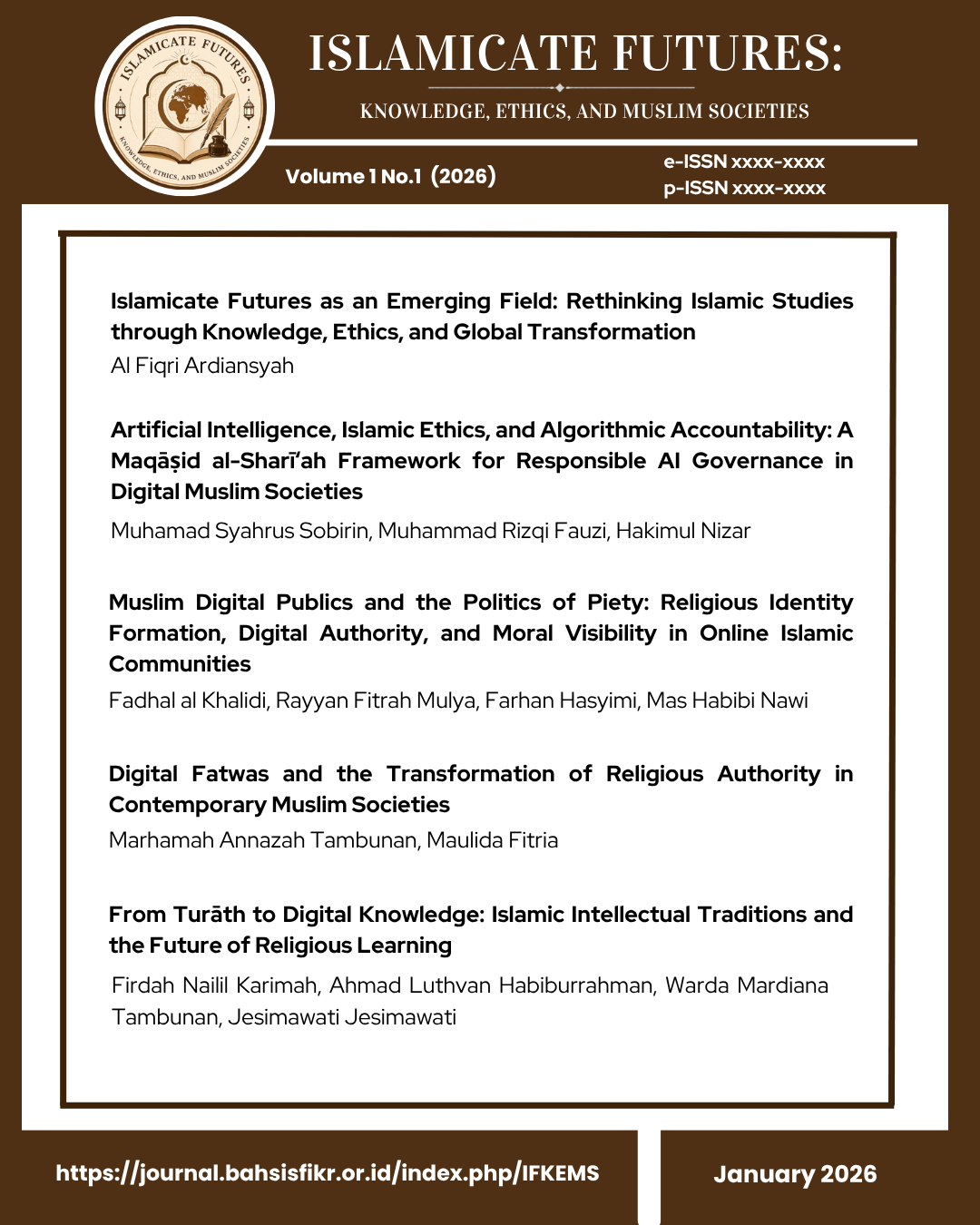
From Turāth to Digital Knowledge: Islamic Intellectual Traditions and the Future of Religious Learning
Keywords:
turāth, digital islamic knowledge, religious learning, islamic education, artificial intelligenceAbstract
The study responds to the problem that Islamic knowledge is now accessed through digital libraries, online courses, social media platforms, mobile applications, searchable databases, and artificial intelligence-assisted tools, yet the epistemic and pedagogical consequences of this shift remain insufficiently theorized. Using a qualitative conceptual-interpretive design, the article combines conceptual analysis, hermeneutic textual interpretation, digital content analysis, and comparative media analysis of publicly accessible Islamic learning materials, digital platforms, and relevant scholarly literature. The findings show four main transformations. First, digital platforms re-mediate turāth into searchable, modular, and platform-dependent knowledge infrastructures. Second, digital learning environments reshape the classical relationship between text, teacher, learner, and institution by redistributing pedagogical authority across platforms, applications, learners, and digital publics. Third, digital Islamic knowledge expands access while also producing epistemic risks, including fragmentation, simplification, decontextualization, and weakened interpretive depth. Fourth, artificial intelligence-assisted religious learning raises future-oriented questions about source transparency, scholarly supervision, privacy, accountability, and ethical governance. The article contributes theoretically by integrating Islamic intellectual history, Islamic education, digital religion, mediatization theory, platform studies, and artificial intelligence ethics into a framework for understanding the future of religious learning. It argues that digital Islamic learning must be governed in ways that expand access while preserving the depth, plurality, discipline, and ethical responsibility of turāth.
References
Abbas, Umar, Mourad Ouzzani, Mohamed Y Eltabakh, Omar Sinan, Gagan Bhatia, Hamdy Mubarak, Majd Hawasly, Muhammad Q Hashim, Kareem Darwish, and Firoj Alam. “Fanar-Sadiq: A Multi-Agent Architecture for Grounded Islamic QA.” arXiv, 2026. https://arxiv.org/abs/2603.08501.
Ahmed, Shahab. What Is Islam? The Importance of Being Islamic. Princeton University Press, 2015.
al-Shamela, Al-Maktaba. “Al-Maktaba Al-Shamela,” July 9, 2026. https://shamela.ws/.
Astor, A, M Burchardt, and M Griera. “Digital Religion and the Reconfiguration of Religious Authority.” Social Compass 71, no. 1 (2024): 3–20. https://doi.org/10.1177/00377686231234567.
Bauer Hinrich A4 - Tunstall, Tricia, Thomas A4 - Biesterfeldt. A Culture of Ambiguity: An Alternative History of Islam. Columbia University Press, 2021. https://cup.columbia.edu/book/a-culture-of-ambiguity/9780231170659.
Bauer, Thomas. A Culture of Ambiguity: An Alternative History of Islam. Edited by Hinrich Biesterfeldt and Tricia Tunstall. Columbia University Press, 2021. https://cup.columbia.edu/book/a-culture-of-ambiguity/9780231170659.
Belinkov, Yonatan, Alexander Magidow, Maxim Romanov, Avi Shmidman, and Moshe Koppel. “Shamela: A Large-Scale Historical Arabic Corpus.” arXiv, 2016. https://arxiv.org/abs/1612.08989.
Bor, A, and H Şahin. “The Nature of Disposition (Fitrah) in Relation with Religion.” Cumhuriyet Ilahiyat Dergisi 22, no. 3 (2018): 1765–88. https://doi.org/10.18505/cuid.448089.
Braun, Virginia, and Victoria Clarke. “Using Thematic Analysis in Psychology.” Qualitative Research in Psychology 3, no. 2 (2006): 77–101.
Bunt, Gary R. Hashtag Islam: How Cyber-Islamic Environments Are Transforming Religious Authority. Chapel Hill: University of North Carolina Press, 2018.
Campbell, H. A. Digital Religion: Understanding Religious Practice in New Media Worlds. Routledge., 2020.
Campbell, H A, and L Connelly. “Religion and Digital Media: Studying Materiality in Digital Religion.” In The Wiley Blackwell Companion to Religion and Materiality, 471–86, 2020. https://doi.org/10.1002/9781118660072.ch25.
Campbell, Heidi A, and Ruth Tsuria. Digital Religion: Understanding Religious Practice in Digital Media. Routledge, 2021.
Cukurova, Mutlu. “The Interplay of Learning, Analytics, and Artificial Intelligence in Education: A Vision for Hybrid Intelligence.” arXiv, 2024. https://arxiv.org/abs/2403.16081.
Daun, Holger, and Reza Arjmand, eds. “Handbook of Islamic Education.” Springer, 2018. https://doi.org/10.1007/978-3-319-64683-1.
Díaz-Rodríguez, Natalia, Javier Del Ser, Mark Coeckelbergh, Marcos López de Prado, Enrique Herrera-Viedma, and Francisco Herrera. “Connecting the Dots in Trustworthy Artificial Intelligence: From AI Principles, Ethics, and Key Requirements to Responsible AI Systems and Regulation.” arXiv, 2023. https://arxiv.org/abs/2305.02231.
franzke, aline shakti, Anja Bechmann, Michael Zimmer, Charles M Ess, and Association of Internet Researchers. “Internet Research: Ethical Guidelines 3.0.” Association of Internet Researchers, 2020. https://aoir.org/reports/ethics3.pdf.
Ghawail, Elhadi A Al, Sadok Ben Yahia, and Mohamed A Alrshah. “Challenges of Applying E-Learning in the Libyan Higher Education System.” arXiv, 2021. https://arxiv.org/abs/2102.08545.
Gillespie, Tarleton. Custodians of the Internet: Platforms, Content Moderation, and the Hidden Decisions That Shape Social Media. New Haven: Yale University Press, 2018.
Günther, S. “Eschatology and the Qur’an.” In The Oxford Handbook of Qur’anic Studies, 472–87, 2020. https://doi.org/10.1093/oxfordhb/9780199698646.013.11.
Hefner, Robert W. Making Modern Muslims: The Politics of Islamic Education in Southeast Asia. Honolulu: University of Hawai’i Press, 2009.
Highfield, Tim, and Tama Leaver. “Instagrammatics and Digital Methods: Studying Visual Social Media, from Selfies and GIFs to Memes and Emoji.” Communication Research and Practice 2, no. 1 (2016): 47–62. https://doi.org/10.1080/22041451.2016.1155332.
Hine, Christine. Ethnography for the Internet: Embedded, Embodied and Everyday. London: Bloomsbury Academic, 2015.
Hjarvard, Stig. “Mediatization and the Changing Authority of Religion.” Media, Culture & Society 38, no. 1 (2016): 8–17. https://doi.org/10.1177/0163443715615412.
Kabir, Md, Md Rayhan Kabir, and Redwan S Islam. “Islamic Lifestyle Applications: Meeting the Spiritual Needs of Modern Muslims.” arXiv, 2024. https://arxiv.org/abs/2402.02061.
Knysh, Alexander. Sufism: A New History of Islamic Mysticism. Princeton University Press, 2017.
Kozinets, Robert V. Netnography: The Essential Guide to Qualitative Social Media Research. 3rd ed. SAGE, 2020.
Marenda, Dinda Ayu, Ahmad Nasikun, and Catur P Wibowo. “Digitory, a Smart Way of Learning Islamic History in Digital Era.” arXiv, 2016. https://arxiv.org/abs/1607.07790.
Nisa, E F. “Creative and Lucrative Da‘wa: The Visual Culture of Instagram amongst Female Muslim Youth in Indonesia.” Asiascape: Digital Asia 5, no. 1–2 (2018): 68–99. https://doi.org/10.1163/22142312-12340085.
Nisa, Eva F. “Social Media and the Birth of an Islamic Social Movement: ODOJ (One Day One Juz) in Contemporary Indonesia.” Indonesia and the Malay World 46, no. 134 (2018): 24–43. https://doi.org/10.1080/13639811.2017.1416758.
OECD. “Corporate Governance and Value Creation.” Paris: OECD Publishing, 2019.
Poell, Thomas, David B Nieborg, and José van Dijck. “Platformisation.” Internet Policy Review 8, no. 4 (2019): 1–13. https://doi.org/10.14763/2019.4.1425.
Rizqullah, Muhammad Ridwan, Ayu Purwarianti, and Alham Fikri Aji. “QASiNa: Religious Domain Question Answering Using Sirah Nabawiyah.” arXiv, 2023. https://arxiv.org/abs/2310.08102.
Rogers, Richard. Doing Digital Methods. SAGE, 2019.
Sahin, Abdullah. “Critical Issues in Islamic Education Studies: Rethinking Islamic and Western Liberal Secular Values of Education.” Religions 9, no. 11 (2018): 335.
———. “The Future of Islamic Education: A Case for Reform.” RE Today 33, no. 3 (2016): 61–64.
Saldana, Johnny. The Coding Manual for Qualitative Researchers. 4th ed. SAGE Publications, 2021.
Salvatore, Armando. The Sociology of Islam: Knowledge, Power and Civility. Wiley-Blackwell, 2016.
Shamsy, A El. Rediscovering the Islamic Classics: How Editors and Print Culture Transformed an Intellectual Tradition. Princeton University Press, 2020. https://doi.org/10.23943/princeton/9780691174563.001.0001.
Slama, Martin. “Social Media and Islamic Practice: Indonesian Ways of Being Digitally Pious.” In Digital Indonesia: Connectivity and Divergence, edited by Edwin Jurriens and Ross Tapsell, 146–62. ISEAS-Yusof Ishak Institute, 2017.
Solahudin, Dindin, and Moch. Fakhruroji. “Internet and Islamic Learning Practices in Indonesia: Social Media, Religious Populism, and Religious Authority.” Religions 11, no. 1 (2020). https://doi.org/10.3390/rel11010019.
Sukron, Mokhamad. “Tafsir Wahbah Al-Z Uhaili Analisis Pendekatan, Metodologi, Dan Corak Tafsir Al-Munir Terhadap Ayat Poligami.” TAJDID: Jurnal Pemikiran Keislaman Dan Kemanusiaan 2, no. 1 (2018): 261–74. https://doi.org/10.52266/tadjid.v2i1.100.
UNESCO. “Recommendation on the Ethics of Artificial Intelligence.” Paris: United Nations Educational, Scientific and Cultural Organization, 2021. https://unesdoc.unesco.org/ark:/48223/pf0000381137.
Downloads
Published
How to Cite
Issue
Section
License
Copyright (c) 2026 Firdah Nailil Karimah, Ahmad Luthvan Habiburrahman, Warda Mardiana Tambunan, Jesimawati Jesimawati

This work is licensed under a Creative Commons Attribution 4.0 International License.